
In 1984, what was the state of Japan’s domestic RPG industry? Landmark media that shaped the genre, such as the video game Dragon Quest (Chunsoft) and the serialized replay Record of Lodoss War (Group SNE), were still two years away. Even D&D was still a year away from receiving its official localization from Shinwa. In other words, while RPGs were beginning to slowly grow, the domestic scene was still in its infancy. As such, in Japan, the RPG was still in the process of being defined. For example, the developer ZAT-SOFT marketed their 1983 sci-fi RPG Poibos Part 1 as an “authentic RPG” (本格RPG), perhaps an attempt to take the lead in the market given that previous titles were rather games of other genres with RPG elements. However, as evident from monthly sale’s rankings and media coverage, there had yet to be a domestic RPG to surpass Wizardry. As far as the video game medium goes, that moment would not arrive until the start of 1984 with Bullet-Proof Software’s The Black Onyx and continue towards the end of the year with Nihon Falcom’s Dragon Slayer and T&E Soft’s Hydlide.

Tabletop (also known as “table talk” in Japan) RPGs found themselves in a similar situation. Published in 1982, the third issue of Hobby Japan’s Tactics magazine pushed the coverage of RPGs in Japan, including an essay on the genre’s history, an actual replay, and even an RPG known as “Donkey Commando.” Developed by one “Al Siddhartha“ (アル ・シダータ), the goal of Donkey Commando was to give readers a sample of an RPG so they could further familiarize themselves with the structure of the genre after having read Shunichi Takanashi’s accompanying article, “The simulation of adventure, adventure’s simulation – What is an adventure role-playing game?”( 冒険のシミュレーション、シミュレーションの冒険――アドベンチャー・ロールプレイングゲームとは). The following year, Bandai made further headway with Space Cobra: The Ultimate Weapon (スペースコプラ最終兵器) and Tsukuda Hobby with Crusher Joe (クラッシャージョウ) and Enterprise: Role Play Game in Star Trek (エンタープライズ: Role Play Game in Star Trek). Amongst their competitors of Hobby Japan and Epoch, Tsukuda Hobby may have been the most reliant on adapting franchises, but they would also be the company to produce the most successful domestic TTRPG out of this crowd of early titles, Roads to Lord (ローズ・トゥ・ロード).1 In contrast to its predecessors, the initial release of Roads to Lord gave way to extended updates and spin-offs, including expansions, supplements, replays, gamebooks, and more.

Released in June 1984, Roads to Lord was designed by Naoto Kadokura (門倉直), a member of the Keio Head Quarter Simulation Game Club (慶應HQ), the university’s analogue game club whose other members at the time also included Yutaka Tama (多摩豊), and Jun Arisaka (有坂純). Elsewhere on campus was the Keio University Fantasy Research Society (慶應大学ファンタジー研究会) which Kazuma Shinjo (新城カズマ) was part of. All four played major roles in the development of Japan’s TTRPG culture. Like Al Siddhartha and Donkey Commando, Tama designed Tsukuda Hobby’s Crusher Joe and Enterprise as a means to introduce the RPG genre to Japan. Arisaka penned one of the first Japanese original scenarios for Call of Cthulhu, “Twilight Angel,” and later, alongside Kadokura and Shinjo, established the game development company, Yūentai (遊演体) who would popularize the “play-by-mail” (pbm) genre with The Adventures of Horai Academy!! (蓬萊学園の冒険!!). In popularizing TTRPG culture in Japan, Keio HQ and Yūentai thereby played a similar role to the Kyoto University Science Fiction Research Club (京都大学SF研究会) and Group SNE.
Like Crusher Joe and Enterprise, Roads to Lord comes packaged in a larger-sized box set, the front cover featuring the game’s artwork illustrated by Naoyuki Kato (加藤 直之). By the time of the game’s release, Kato had already been working as an illustrator on various science-fiction and fantasy works, drawing covers for magazines and books, including Hayakawa Publishing’s SF Magazine (S-Fマガジン), Kaoru Kurimoto’s (栗本 薫) Guin Saga, and Yoshiki Tanaka’s (田中 芳樹) Legend of the Galactic Heroes. Tsukuda Hobby themselves had trafficked in developing SF wargames and RPGs that were split across various divisions grouped under the “HG” umbrella. Roads to Lord was part of the SF-SERIES, being labeled as SF-SERIES30 and HG-30R. Other titles in the SF-SERIES included wargame adaptations of popular mecha anime, such as Heavy Metal (SF-SERIES31/HG-031) and Genesis Climber (SF-SERIES28/HG-028.

Retailing for ¥4,800, roughly ¥5,658 or $35 by the standards of 2026, the contents of my own copy of Roads to Lord are as follows:
- x1 Rulebook, 16 pages.
- x1 World Guide, 19 pages.
- x1 Scenario book, 20 pages.
- x1 Double-sided charts for character creation and items, 6 pages.
- x4 Miniatures.
- x25 Hex tiles.
- x2 Six-sided die.
- x2 Percentile die.
- x62 Monster counters split across the following:
- x1 SNAKE
- x2 “small size” DRAGON
- x2 “large size” DRAGON
- x3 TROLL
- x4 ELF
- x5 MAGICUSER
- x5 VAMPIRE
- x5 SKELTON (sic)
- x5 DWARF
- x5 WOLF
- x5 GOBLIN
- x10 HUMANS
- x10 OGRE/OGER (sic)
- x99 Spell cards. These are actually 33 spells (with names written in English) that each have 3 duplicates. These spells are further split by their elements, A (air), B (black), E (earth), F (fire), M (mind), T (water), and W (white). The decks are as follows.
- A: Fly, Invisible, Lightning Bolt, and Tornado Spin
- B: Counter Spell, Dark, Death Spell, Fear, Poison Blow, and Summon Undead.
- E: Ask Stone, Cracks, and Dimension Reconstruct
- F: Fire Ball, Fire Pole, Fire Storm, and Tinder Finger.M: Marionet, Sleep, Speed, Summon Monster, Telepathy, Teleport, and Transform.
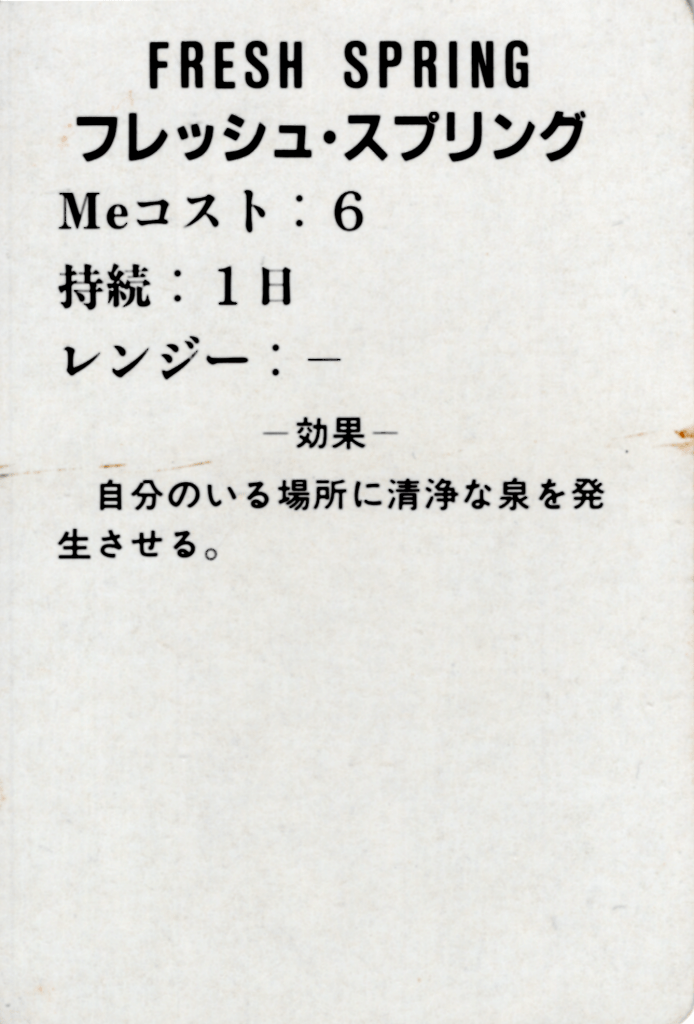
- T: Aquarang, Extinguish, and Fresh Spring.
- W: Healing, Holly (sic) Light, Magic Shield, Peace, Protection, and Resource.
While I am missing character sheets and a box that holds all these materials, I believe that this set contains all the major components of the game.
The world guide is largely split into sections. The first half details the major kingdoms, their history, and their culture. The second half functions as something of a monster bestiary, detailing enemy stats and descriptions.
Roads to Lord takes place in the land of Yuruselum (ユルセルーム), a continent and surrounding islands located in the northern hemisphere of the world consisting of four major kingdoms: Stradium (ストラディウム), Endardium (エンダルディウム), Pharaizon (ファライゾン), and Dura (デュラ). As described by the world guidebook’s timeline, in ancient times, Stradium, Endardium, and Pharaizon were united as one empire locked into war against the northern demon kingdom Dura located in the north and Hyunō (ヒュノー) located in the south. However, in the year 1504, the capital of the united kingdom, Endarnoum (エンダルノウム) was sacked, leading to the remaining three kingdoms to divvy themselves by their bloodline.

Yuruselum has two schools of religion: Ivo (イーヴ ) and Dūr (デュール) which function as opposing beliefs. Whereas Ivo follows the mantra of “eternity through harmony” (調和による永遠),” Dūr instead believes in, “rebirth through destruction” (破壊による再生). The united kingdoms practice Ivo. In contrast, Dura and Hyunō practice Dūr. The Ivo school hosts a pantheon of gods that are worshipped by the different races, but those who follow Dūr only believe in the god of Dūr.
What follows from here is the Yuruselum creation myth which details how the supreme god “Havael” (ハヴァエル) created the “Sīra,” (シーラ), lesser gods who themselves went on to create worlds. Among the Sīra were the gods Ivo, the wisest, and Dūr, the mightiest. These opposing attitudes eventually led to the two gods creating intelligent races in their own image. Fairies are born from Ivo and humans from Dūr.
The World Guide also introduces the major regions of Yuruselum, detailing their history, special areas, geography, and more. For the sake of brevity, I’ll only briefly touch upon these areas.
First there’s Stradium, a military and maritime trading nation located in the southwestern tropics of Yuruselum.
The fairy kingdom of Auron (アウロン) lies to the west of Yuruselum and falls under the protection of Stradium although it remains independent. Auron is particularly famous for having helped defend Stradium from invaders long ago and for its coastal landscape, the “Auron Shore Road” (アウロン浜道).
Rodanizon (ローダニゾン) and Duron (ドゥーロン) are duchies under the protection of Stradium and are also located in the west. They are home to fairies and halflings.
Lira (リラー) is a remote and harsh region located in the north.
Hyunō is a volcano island located in the south of Yuruselum and is inhabited by those who worship Dūr. It is an authoritarian kingdom ruled by the high elf and sorcerer Agard (アガルッド)
Een (エーン) is an isolated island in the southwest of Yuruselum that has become a base for pirates.
Elda (エルダ) is a forest region in the northeast of Yuruselum and home to fairies.
Ramzas (ラムザス) is a steppe region located in central Yuruselum whose people are skilled in horseback riding.
The Dura empire lies in the northwest and is ruled by Yureeg (ユレーグ) who seeks to conquer all of Yuruselum.
Finally, in the east is Yuruselum’s oldest kingdom, the holy capital of Pharaizon.

Characters are defined by the following stats: Strength (St), Dexterity (Dx), Mental (Me), and Charisma (Cr).
Here, skill checks are called “real roll” (リアルロール), abbreviated as “RR.” Real rolls are carried out by rolling 2d6 and adding the total sum to the relevant ability score. As the listed example explains, if an adult human wanted to jump across a river, they would need an RR of 15 or higher. The average adult human has about 8 strength, meaning they would need to roll a combined total of 7 or higher to successfully make the jump.
Additionally, the game also uses two percentile dice, one dice representing 00 – 10 and the other 00 – 100. These percentile dice are first used in character generation. Players will roll the percentile dice and then consult the character generation chart to understand the results. For example, here are the results for the following races:
01 ~ 50: Human (人)
51 ~ 65: Fairy (妖精)
66 ~ 80: Dwarf (ドワーフ)
81 ~ 94: Halfling (ハーフリング)
95 ~ 98: Shape-Changer (シェイプ・チェンジャー)
99: Half-Fairy (半妖精)
100: Giant (巨人)
These are then further broken down into subdivisions. For Humans, this includes:
01: Royal Family (王室)
02: Nobility (貴族)
03: Bishop (主教)
04 ~ 07: Priest (祭司)
08 ~ 10: Knight (騎士)
11 ~ 20: Soldier (戦士)
21 ~ 45: Citizen (市民)
46 ~ 49: Gypsy (ジプシー)
46 ~ 49: Lost Royalty (ロストロイヤル)
Readers may have noticed that the “Gypsy” and “Lost Royalty” subdivisions are both listed under the result of rolling 46 ~ 49. I do not know whether this is due to a specific printing error, but notably, my own copy of the character generation table features “fixes” made by whatever owners this copy of the game has passed through in the last forty years. Lost Royalty is changed from 46 ~ 49 to 50. As a result, two Fairy subdivisions have also been changed. The roll for the “ High Elf” (上級エルフ) subdivision has been modified from 50 to 51, and Elves (エルフ) have been changed from 51 to 63 ~ 64, a range that was entirely absent. These backgrounds do not completely determine who a character is but certainly shape how the character engages with and is engaged by the world. For example, human royalty begins with 50 gold whereas human lost royalty only begins with 1. Certain subdivisions also have special skills, such as knights being capable of horseback riding (乗馬の技術を有す).
Each subdivision also has its own modifiers for determining ability score which themselves are categorized by base value (基本値), growth modifier (成長修整), and growth limit (成長限界). Initial ability scores are thus determined by adding the result of a 1d6 to the base value. For example, if I were to roll human royalty, who have a base value strength of 4, and I then rolled a 3 for determining their initial strength, their total starting strength would be 7.
When leveling up, characters will roll a 1d6 for each ability score and then add or subtract their growth modifier from that result. This number is then added to their ability score. Using the same example of human royalty, if I were determining my strength after reaching level 2 and rolled a 4, as per the chart, I would then subtract 3. I would then add the resulting 1 to my starting strength of 7 for a total of 8.
Races also bring with them unique abilities, such as fairies only requiring 3 hours of sleep and dwarves being capable of seeing in the dark.

Upon completing certain requirements, characters gain “titles” (称号) which come with additional benefits. Some examples include Necromancer (降霊術使), Hero (ヒーロー), and Sage (賢人). To become a Necromancer, players need to satisfy the following conditions.
- An “Me” stat of 15
- Level 3 or higher
- Possess the title of “Mage” (魔術使い)
- Proficiency in the spell “Summon Undead” (サモン・アンデッド)
As a Necromancer, when casting “Summon Undead,” characters can specify what type of creature is being summoned.

Spells can be learned by fulfilling certain requirements during the scenario. Once these are met, the GM will shuffle the deck of spell cards, lay them face down, and allow the player to draw a card of their choice. Neither the GM nor the player can look at the front of the card. Rather, the spell is only revealed once the player has cast it. Should the spell be successfully activated, characters will learn the spell and can write it down in their character sheet but may not write down the specifics of the spell, such as its Me cost, range, duration, and effect. Rather, this must be memorized by the player. The spell card is then returned to the deck. Should players draw a spell they’ve already learned, they gain proficiency in that spell.
If a character’s Me falls to 0 while attempting to cast a spell, not only will the spell fail to activate, but the character may forget the spell, even if already learned. This is determined by the roll of 2d6. If the Me cost of the casted spell is greater than the result, then the character loses that spell. The sole exception is for spells that the character has mastered in which case are only forgotten if the Me cost exceeds twice the dice result.


Before a scenario begins, characters may spend a year training a skill with the result being determined by a combination of dice rolls and the GM. The rulebook provides a simplified version of this process.
- Characters must successfully find a trainer.
- Characters must then be successfully accepted as the trainer’s student.
Skills include Horse Riding( 乗馬), Sea Faring (操船), Medicine (医術), Espionage (スパイ), and Language (言語).
To help facilitate roleplay, Roads to Lord also features a communication chart (コミュニケーション表) to be used by the GM. Using a combination of real rolls based on Cr, this chart determines how NPCs will react to players. For example, a real roll of 35 or higher bears a chance of an NPC joining the party or even falling in love. In contrast, a real roll of 7 or less results in the NPC either attacking the party or fleeing.

Combat takes place on a hex-grid map with each character having a specific range of movement. The combat board is constructed by combining the various tiles which is left up to the discretion of the GM.
Turn order is determined by dexterity with characters and monsters having higher dexterity moving faster. Combat itself is composed of several different actions. First, there’s general movement (移動) which entails moving into a hex that is not adjacent to an enemy. Changing direction costs one movement point.
Hexes are composed of front and rear areas. Under normal conditions, when attacking, targets must be located in the front. If a unit wanted to melee attack a target a few hexes away, they would first have to declare “engagement” (交戦) which reduces their movement by half but allows them to approach the target for combat.
Whether or not an attack hits is dependent on the difference in Dx between both units and the overall percentage can be determined by using the “Hit Determination Table” (命中確認&白兵戦成否表). The rulebook uses the following example. If a unit with 8 Dx engages a unit with 9 Dx, then the difference is -1. Yet, consulting table reveals the closest numbers are 0 and -2. Defenders always receive the more favorable number. In this case, it means that attacks will only hit when rolling a 45 or less. If the attack is successful, the unit then rolls the appropriate dice and adds the relevant modifiers.

Beyond engagement, units can also occupy the same hex as an opponent for close-quarters combat (白兵戦). Successfully entering close-quarters is also determined using the hit table. Once two units are in close-quarters, there are three ways for it to end. A unit’s St becomes 0 and dies; a unit’s Me becomes 0 and falls unconscious; or a unit successfully disengages from combat. Disengaging costs half a unit’s movement allowance and the disengaging unit must make a successful roll using the hit determination table as reference.
Finally, units can also rest but it requires being in a position where they cannot be attacked, being three hexes away from enemies, and taking no other action. By resting during combat, units can recover their Dx and Me.
Experience points are earned through a variety of activities, including defeating enemies in combat, escaping combat, completing scenario objectives, casting spells, and successful real rolls. Accumulating EXP allows characters to use advantage points (アドバンテージ・ポイント) which can be added to dice rolls affecting the character’s own actions. Upon leveling up, ability scores are increased by the result of a 1d6 added to the appropriate growth modifier.
Bear in mind that I have far from described the entire world guide and rule book but have instead aimed to explain various aspects of the game to the extent of establishing a lay understanding. The rules in particular are both extensive but also leave room for possible changes, such as the removal of the combat board or the addition of a “Luck” (Lk) (ラック) stat.
The game comes with two scenarios and one side story. Respectively, these are, “The Witch’s Cave” (魔女の洞窟), “The Black Tower of Mirea Island”(ミレア島 ブラック・タワー), and “Scenario I: Side Story” ( シナリオ I サイドストーリー).
The Witch’s Cave is introduced as a scenario for players new to RPGs or those who are lacking in experience with the recommended party size being 1 ~ 3 players. At about 4 ½ pages in length, the structure is similar to that of a gamebook. There are “99” steps which function as page numbers. The Witch’s Cave opens with flavor text introducing the scenario. While sleeping, the party experiences a nightmare where they are pulled into a ring of fire. The scenario then begins at step one with the party finding themselves in a room, standing on a magic circle. They catch sight of a witch who immediately vanishes. Removing the torch from the wall, a single exit from the room takes the party to step 40. There, the party encounters a trapped spirit. If they rescue it, they go to step 32. If they do not, they go to step 16. It is in this manner that The Witch’s Cave plays out. The dungeon here is labyrinthine and the structure of the game means that party members cannot simply walk out. Steps present opportunities for combat and other assorted events. For example, step 33 has a mandatory encounter with a skeleton whereas step 99 instead has an opportunity to drink a potion. The ultimate goal is to reach step 36, the exit of the cave which leads directly to the second scenario.

In contrast to The Witch’s Cave, The Black Tower of Mirea Island is where Roads to Lord truly begins with the GM being given much more freedom in determining how the scenario will play out, and players being allowed the chance to both explore and properly role-play. From the outset, there are several major locations that can be visited, including the titular Black Tower, a harbor, and a village. The rest of the scenario plays out much like a standard RPG. There are a variety of smaller locations to visit, NPCs to speak with, skill checks to be made, monsters to fight, treasure to loot, and of course, dungeons to conquer.
The side story included at the end is a short story whose narrative explains the larger circumstances behind both scenarios. It is roughly 2 pages and details the history and actions of major characters within the scenario. Rather than being read on its own, at the end of the scenario, GMs are given an opportunity to tell the story within the diegesis.
While there can be no doubt that D&D’s influence looms over the development of Japanese RPGs, Roads to Lord draws from and iterates upon several games of the era. According to Kadokura, besides D&D, this also includes DragonQuest (SPI, 1980), RuneQuest (Chaosium, 1978), Tunnels & Trolls (Flying Buffalo, 1975), Melee (Steve Jackson, Games, 1977), Death Test (Steve Jackson, 1978), Silver Dragon,2 and even computer RPGs.3 Although D&D and many other RPGs had yet to be translated, it was precisely these games that Japanese players were engaging with, turning towards magazines and fellow club members to learn how to play. Kadokura previously described the primary goal of Roads to Lord as creating an RPG that was “smoother” (よりスムーズ) than imported titles, one with versatile systems (より応用範囲の広い).4 He had thus understood the importance of player creativity beyond the confines of just playing the game but also of shaping the game itself. While Enterprise and Crusher Joe were enticing precisely because they were based on pre-existing licenses, Roads to Lord was instead an original title. If Kadokura wanted players to enjoy the world enough to be willing to expand or change the game, it would be necessary to first create a world appealing enough in the first place. Consider that the included scenario takes place within a single, remote location, the inclusion of the expansive world guide is meant to serve as a sandbox for players. It is perhaps for these reasons surrounding player creativity, as well as not being beholden to potentially fraught licensing deals, that Roads to Lord was successful in ways that its predecessors were not.

After its release, Roads to Lord continued to receive extensive support from both Tsukuda Hobby and fans. In 1985, game designer and magazine editor, Ginichiro Suzuki rebooted the wargame/RPG magazine Simulator (シミュレイター), now publishing it under his new company Shōkikaku (翔企画). Featuring higher production value, this new version of Simulator continued the mission of its predecessor, covering historical wargames and the burgeoning RPG genre. The first issue saw the publication of the Roads to Lord replay, “The Seven Altars” (七つの祭壇), written by Tomoyuki Fujinami (藤浪智之). While Fujinami went on to become an established game designer himself, at the time that he wrote “Seven Altars,” he was only a high-school student who been producing doujinshi on simulation games with his group of friends, the circle Outbarn (アウトバーン). Encountering Outbarn’s work at a game convention, Suzuki was impressed and commissioned the group to write a replay. Contrary to popular belief, replays were not invented by Record of Lodoss War. As mentioned earlier, the genre had been around since 1982 with the publication of Tactics’ “The Adventure of the Wandering Knight Eltzwagner: An example of role-playing gameplay” (放浪の騎士エルツリグナーの冒険:ロールプレイングゲームの実例).5 Yet, unlike later replays, these early replays were not serialized narratives but were instead created to give readers an example of how RPGs were actually played. What Record of Lodoss War did pioneer was the serialized dramatic replay in which readers grew attached to specific characters, such as Parn and Deedlit, rather than the game itself—the characters of Lodoss would appear in different systems, including D&D, Sword World, and Tunnels and Trolls. Fujinami’s “The Seven Altars” took a similar approach.
“The Seven Altars” centers on a group of adventurers, who all live in the same boarding house, escorting their landlady (理人さん) to the remote village of Noiru (ノイル村) after she receives a letter from an old friend asking for help. There’s Momo-chan (モモちゃん) the Mage Undine; Cream Taro (クリーム太郎 ) the Priest; Red Bear (赤熊) the Dwarf; Morning Afternoon (モウニング・アフタヌーン) an Elf of Lost Royalty; Chris Alp (クリス・アルプ) a half-elf, half-human; and Joe Yakult (ジョー・ヤクルト), a human gypsy. Comedic in tone in ways that prefigures later fantasy, such as Slayers (Hajime Kanzaka, 1989 – ), the adventure takes on several twists and turns. The party is defeated by bandits, find a village being held hostage by a vampire, and eventually take on the mythical trial of the seven altars. The replay not only features a full and dramatic narrative, replete with drawings which bring the story to life, but it also touches upon the systems of the game, such as combat and rolling, although this aspect is relatively minor. Regardless the style of “The Seven Altars” as both a replay and dramatic narrative no doubt serves as a bridge between earlier replays which functioned as tutorials and Record of Lodoss War.

From its initial release, up until 2002, Roads to Lord steadily received spin-offs, expansions, and supplements, including the game’s system being used to adapt the Guin Saga into a TTRPG, certainly a boon for the budding franchise as the novel was popular in RPG and fantasy circles. As for the base game, it received two expansions. The first, “Nahan/Ramzas.” The second, “Stra・Diumn,” was sold across three smaller supplements which were later bundled as a deluxe set. In 1987, Kadokura wrotes two gamebooks to be published by Hayakawa’s game book division: Lost Body: Witch Dinon 1 (失われた体 魔法使いディノン 1) and The Hunter of Fire and Darkness: Witch Dinon 2 (闇と炎の狩人 魔法使いディノン 2).

In 1989, a new edition to the game was released, Beyond Roads (ビヨンド・ローズ・トゥ・ロード), also known as “B-Roads,” which was aimed at a more intermediate RPG crowd. Consider that by this point in time, the concept of RPGs had become firmly established in Japan. Imported titles such as Traveler, D&D, Call of Cthulu, and Tunnels and Trolls had all been localized. So too did Japan’s domestic industry experience its own boom with games such as Wizardry RPG (ASCII, Group SNE, 1988), Wares Blade (Hobby Japan, 1989), and of course, Sword World (Group SNE, 1989). In other words, compared to 1984, the situation was completely reversed and it could no longer be assumed that players were ignorant of RPGs and their complex systems. With B-Roads, Kadokura radically altered the weapons and magic system. Weapons and armor grew in power with usage but were also rendered fraught by durability. As Hitoshi Yasuda explains of the mechanic in his Introduction to Tabletalk RPGs, should the weapon or armor break, its owner would also “feel” (感覚的) the pain.6 The magic system would retain the use of cards which this time represented images rather than the actual spell itself. Players would then craft their own spells by combining these images.
B-Road itself received one supplement, “Shade of South: Night of the Mutant Hybrid Sorcerer” (Shade of South: 変異混成術師の夜), and in 1991, Kadokura penned a twin set of books meant to introduce RPGs readers to through the example of B-Roads, A Practical Introduction to RPGs by means of Beyond Roads to Lord (ビヨンド・ローズ・トゥ・ロードでわかる実践RPG入門) and volume 2, Earth Spirits (精霊の大地―).


A third Roads to Lord followed suit in 1993, this time designed by Fumio Tsukasa (司史生) and Tomoyuki Fujinami (藤浪智之), the game itself receiving a plethora of supplements. Kadokura returned in 2002 with Roads to Lord which also received a string of expansions, and then in 2010 a new game in the series, The Wander Roads to Lord also known as W-Roads.
Despite its storied reputation and a steady stream of games and expansions, there might be questions as to why Roads to Lord isn’t more well known, especially when later titles like Tenra Bansho Zero (F.E.A.R., 2000) and Double Cross (ダブルクロス)(F.E.A.R., 2001) have received English translations. Even now, an official English translation of Sword World 2.5 and Wares Blade is currently under works by Lion Wing Publishing. On this point, it’s worth noting that in 2020, with permission from Kadokura, game designer and scholar, Akira Okawada (岡和田晃) shared a simplified version of the ruleset for W-Roads.7 Regardless, Roads to Lord was a pioneer of Japanese fantasy TTRPGs and my own impression is that those who are aware of the game recognize its importance. Perhaps Roads to Lord arrived too early and by the time of B-Roads, the market had grown saturated. Yes, players were familiar with RPGs, but as game designer Yukihiro Kuroda (黒田 幸弘) points out in his first RPG column in a running series published in Comptiq, players were more familiar with CRPGs than they were TTRPGs.8

Furthermore, the juggernaut success of Record of Lodoss War and subsequently Sword World is partly owed to the backing of the corporate giant that is Kadokawa and their successful media mix strategy. While there were later replays of Roads to Lord beyond “The Seven Alters,” and even a pbm serialized in Marukatsu PC Engine (which itself was published by Kadokawa!) there was no Roads to Lord OVA, no anime series, no manga, and no light novel.9 The sole video game Wasureenu Honoo: Ardor Aeternus (Yūentai) didn’t arrive until 1996. Yet, it would still be incorrect to call Roads to Lord a failure by any means. Rather, the franchise simply remained successful in its own niche.


In 1984, D&D may have been a decade old, but Japanese players still lacked a full-fledged fantasy TTRPG that was readily available in Japanese. Kadokura successfully created an original game that could and would be expanded by both himself and other players, whether that meant homebrewing their own rules, writing replays, or participating in pbm sessions. The systems here emphasize a freeform approach, leaving room creativity in terms of both combat and roleplaying. Equally appealing is Yuruselum. With its stories of broken kingdoms, impending invasions, and dying heroes, it is ultimately a world both tragic and romantic.
END NOTES
- In 1983, alongside Enterprise and Crusher Joe, Tsukuda Hobby also released Midgard: The Battle for the Lost Key (ミッドガルド-失われた鍵-), a strategy game with RPG elements which was marketed as “The Game of the Battle on Fantasy Land.” ↩︎
- Kadokura simply calls it “Silver Dragon,” but I assume it must be Howard Thompson’s 1980 Treasure of the Silver Dragon. Treasure of the Silver Dragon uses the same rule system as The Fantasy Trip which Death Test was also designed for. ↩︎
- Naoto Kadokura, “特集! ファンタジーワールド “Roads to Lord “現わる! 門倉 直人,” Operation, Vol. 6 (1984), 2. ↩︎
- Naoto Kadokura, “特集! ファンタジーワールド “Roads to Lord “現わる! 門倉 直人,” 2. ↩︎
- At least one other early example of a replay included Hitoshi Yasuda’s overview of Traveler in issue 18 of Tactics. ↩︎
- Hitoshi Yasuda, テーブルトークRPG入門, (Micro Design, 1991), 225. ↩︎
- This can be found on a note blog post by Okawada, here. ↩︎
- Yukihiro Kuroda,“クロちゃんのRPGロールプレイン講座: ロールプレイングゲームの世界,” Comptiq, vol. 13 (Tokyo: Kadokawa Shoten, January 1986), 162. ↩︎
- Kadokura did, however, publish two short stories: “Firefly Night Festival” (ホシホタルの夜祭り) and “The Tale of Gund” (グンドの物語) ↩︎
BIBLIOGRAPHY
Kadokura, Naoto. “特集! ファンタジーワールド “Roads to Lord “現わる! 門倉 直人,” Operation, Vol. 6 (1984). 2 – 3.
Kuroda, Yukihiro. “クロちゃんのRPGロールプレイン講座: ロールプレイングゲームの世界.” Comptiq, Vol. 13 (Tokyo: Kadokawa Shoten, January 1986). 162 – 165.
Yasuda, Hitoshi. テーブルトークRPG入門 (Micro Design, 1991). 225 – 226.
Amazing article! Thanks for sharing all this compiled research into Roads to Lord. Really informative and well-presented.